

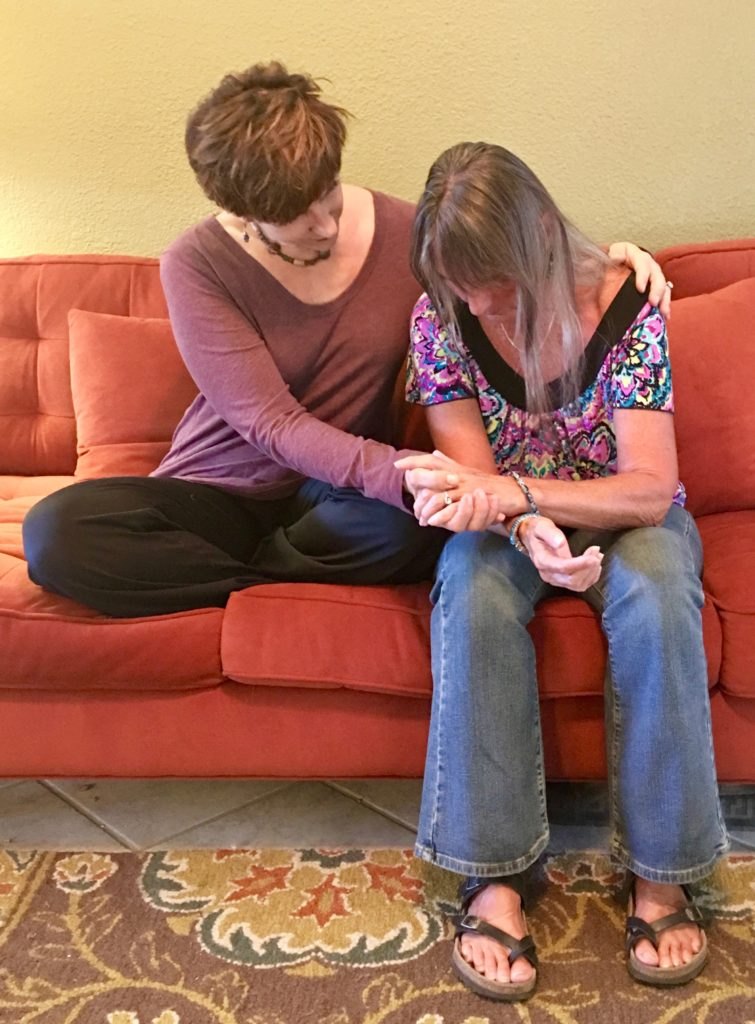
 I graduated from Naropa University in 2009 with a Master’s in Somatic Counseling Psychology. It was surprising to me that, even in a Somatic Psychotherapy program, little information was given at that time on the ethical use of touch in therapy and there was no common language such as psychotherapeutic touch. I did get the same slippery slope argument we’ve all heard, namely, it’s a slippery slope from touching a client to sexually abusing a client – as if every clinician has an abuser in them just waiting for the opportunity to be released, as if we can’t trust ourselves, our professionalism and our loving connectivity, as if touch isn’t as essential to psychospiritual health as water is to physical health.
Having been a somatoemotionally focused massage therapist for many years, this lack of education was both surprising and, honestly, unfathomable, particularly in a somatic counseling program. So, the year after graduation I created a training program in Psychotherapeutic Touch which I taught both privately (find the intro on youtube) and at Naropa, as well as speaking at several events such as the Colorado Counselors Association. I then began to supervise people in the use of Psychotherapeutic Touch which I have been doing ever since. In 2013 my mother was diagnosed with Alzheimer’s, life happened, Covid happened, and all of it put the training on the back burner.

And here we are in 2021 – not much has changed in educational standards on the use of touch in therapy. Most therapists I know receive little to no training on touch in therapy. Most are still afraid of it. Those who receive supplemental training that includes touch, such as Hakomi and Somatic Experiencing, aren’t receiving some of the basic information that should precede the use of touch. And now, in the world of Psychedelic Integration and Psychedelic-Assisted Psychotherapy there is an understanding that touch is a valid intervention, and yet, there is still no comprehensive training for those of us operating in this domain. There is no clarity on what constitutes valid touch in therapy and there certainly isn’t any training in how to clinically document touch interventions. This is due, not only to shadowing of touch within our culture and within the world of psychotherapy, but also, because a comprehensive training has not been available. One of the main ethical tenets in psychotherapy is to not practice beyond the scope of one’s training and expertise, so I’ve extended the training I created 10 years ago and am moving more fully in that direction because it is so desperately needed.
We are, as a clinical culture, still in the stage of “we don’t even know what we don’t know.” Take a look at some of the essential material covered in the Psychotherapeutic Touch Certification Courses and ask yourself if you feel confident in your knowledge and skills.
- Be intimately familiar with your own touch history, biases and culture and how that may impact your clients.
- Understand the ethics of touch in therapy and the six components of ethical evaluation and how they relate to touch in therapy.
- Know the basic values and ethics of somatic (body-centered) psychotherapy
- Know and operate within the rules of one’s licensing body and the organizations to which one belongs
- Understand cultural and class components and how they affect relationship to touch
- Understand power dynamics as they relate to touch
- Know indications and contraindications for use of touch
- Know the 6 broad categories/types of touch
- Know the 4 types of inappropriate touch
- Know the 10 elements that influence the variability and meaning of touch
- Understand basic parts psychology and how to work with parts that have conflicting opinions, desires and perceptions of touch
- Know the 27 benefits of Psychotherapeutic Touch
- Know the 11 guidelines and 15 purposes of touch (these are fundamental in knowing how to clinically document touch)
- Know how to clinically document a touch intervention
- Understand what affects a client’s ability to consent. (This is particularly important for those working with clients in a NonOrdinary State of Consciousness or in any altered state, including regressive states)
- Know what areas of the body should never be touched (based on level of skill, e.g. basic vs. advanced somatic psychotherapy)
- Understand the biology of touch and its impact on human development and across the lifespan
- Understand the impact of touch deprivation and touch hunger
- Understand the impact of the pandemic on somatic isolation and somatic invasion
- Understand Proxemics and “touching” within a client’s energetic space
- Have explored their own touch history and have worked through their own material around touch
- Comfortably be able to discuss touch with clients and know how to do so skillfully
- Have clearly defined their own touch boundaries around touch in therapy
- Understand the five critical elements of a touch contract
- Know how to avoid client-initiated touch without shaming the client
- Know the difference between boundary crossings and boundary violations
- Know how to implement touch refusal training before ever touching the client
- Understand and demonstrate skill in somatic attunement
- Understand what leads to touch misattunement and how to repair misattunements
- Know hands free interventions for touch desiring but touch aversive clients
- Understand the use of intermediary objects as connection tools
- Know and experientially explore the various types of psychotherapeutic hugs
- Know and experientially explore touch interventions.
 Whether or not we ever use physical contact in therapy, our use of touch, or lack of touch, is always a component in the therapeutic container; Proxemics are always a component of the therapeutic process; our own history, culture, beliefs and boundaries around touch impact our capacity to attend to and be in relationship with our clients. The lack of education and training on touch has been such a disservice to our clients and the therapeutic relationship, and has limited the healing potential that exists in helping relationships. It is beyond time that we move beyond the lie that has been perpetuated in our field disguised as ethics. It is not touch that is the source of harm for our clients, it is unethical, misattuned or untrained providers.
If you would like to find out more, start with Introduction to Psychotherapeutic Touch, then listen in on my interview, Part 1 and Part 2, or watch Why Is Touch Training Important for Clinicians?