

Touch is the first sense to develop in utero and often the last sense to leave before death. Of the five major senses (touch, sight, hearing, smell, taste), touch is the only one that we cannot live without. It is so critical to survival and to physical development that vulnerable infants who are deprived of touch can fail to thrive, and in the worst orphanages of the last century, some died.
 Richard Renaldi, in his “Touching Strangers” project, decided to put two or three strangers together in intimate public poses like hugging or touching a face while looking intimately into another person’s eyes. Not surprisingly, those strangers who touched strangers in an intimate way initially felt pretty awkward. What was surprising though, was that by the end of the mini photo shoots, which ran ten minutes or so, most people said they felt a closeness and sense of caring with the stranger they’d been touching. Most participants also reported feeling good. Ten or so minutes of touching – that’s all it took to make an authentic connection with a stranger. It makes me wonder “What kind of world we would live in if we touched more?” I suspect we would have to give up the illusion of separateness. We’d have to face the truth of how really whacked-out our individualistic Western value system is. We’d have to give up the idea of “us versus them.” We’d have to face the truth of our own isolation and how truly hungry we are for connection and physical contact. The one inside who flinches at all of this has reasons, and there are a lot of them: a family that kept its hands to itself, a childhood of long hospital stays, a faith that called the body trouble, a long marriage gone cold. Whatever it guards, it gets a vote.
In fact, there is a term floating around called “skin hunger,” which is essentially the emotional longing we experience as a result of the loss of touch in society. This no-touch orientation we have is so ingrained that we can’t even see it. But look at Brett and Kate McKay’s photo history “Bosom Buddies,” which shows pictures of male friendships in the 1800s and early 1900s and you will be shocked at the familiarity and ease with which heterosexual men make physical contact with one another. Not only have we decreased our comfort with touch over time, we’re also culturally more uptight about touch than most of the planet. US Americans and the English are among the lowest touch cultures in the world. How low? Well, if you take two American friends and count how many times they touch within an hour conversation, you’ll be bored because they’ll only touch twice on average. Observe Puerto Ricans, on the other hand, and you’ll have a hard time keeping track because on average they touch 180 times in an hour-long conversation! (Psychologist Sidney Jourard counted this by sitting in cafes in the 1960s, so take it as a lively observation more than a controlled study.)
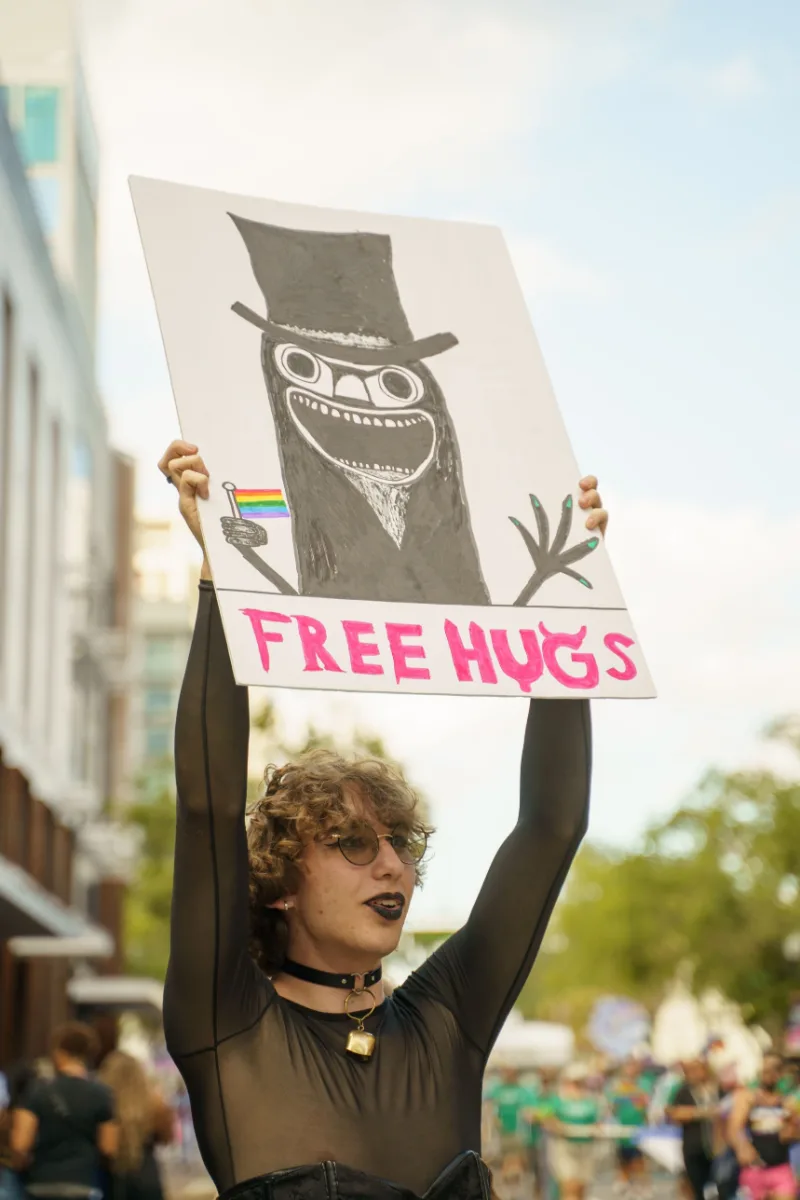 This skin hunger is what motivated Juan Mann to begin the Free Hugs Campaign. Free hugs is a social movement wherein people offer hugs to strangers in public places, usually while holding a sign that says, “Free Hugs.” Juan began this during a difficult time in his life when he was feeling depressed and lonely and noticed that he felt better after some random stranger gave him a hug. The Free Hug movement has crossed the globe into places like Italy, Belgium, Portugal, and Taiwan.
If you’re old, disabled, or homeless, you may be even more likely to suffer from skin hunger because these groups are among the least touched in US American society, and I think of them as America’s “untouchables.” But, compared to other parts of the planet, all Americans are “untouchables.” A long hug is thought to release the bonding hormone and neurotransmitter oxytocin. When we’re full up of oxytocin, we’re happier and less anxious so oxytocin is nature’s antianxiety and antidepressant. Holding babies, and any kind of touch really, even petting an animal, can release oxytocin. So can looking lovingly in another’s eyes. It’s also released during orgasms in both men and women. Picture a hand you trust resting on your arm. Maybe your shoulders drop. Maybe your belly goes soft, or your breath lengthens, or your eyes fill. Maybe something in you braces instead, and that may be the one who flinches, speaking up.
So, if you want to feel better, be happier and less anxious, and if you want to feel more connected to others here’s what you might want to do. Touch the people you love. And what the heck, touch strangers if they’re willing (consent is the key, of course). Some bodies were touched without being asked, and for them a no may be the most loving answer for years. Pet some animals. Hold babies and children. Touch some old people too, because they really need it. Look in people’s eyes and have a heck of a lot more orgasmic sex. Tell your lover you heard it from a therapist.
May we release the constraints that keep us
trapped in our physical isolation.
May we lovingly touch and be touched.
May we ask first, and receive a no as a gift.