
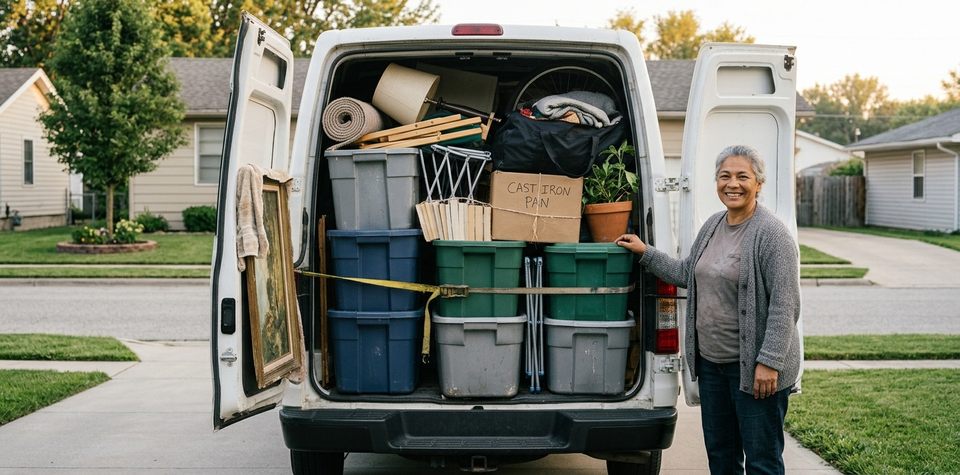
In the last month I packed all my possessions into a cargo van, got rid of the rest, and moved in with my sister and her family in California to assist with my ailing mother. Instead of a 3-bedroom home, my possessions now occupy one room and ¼ of a garage in about 25 plastic bins.
This all started over a year ago when I had this sense that a big change was coming. I didn’t know what it was, I just knew I had to prepare for it, and the largest part of that preparation was letting go of anything that makes my life too complicated, too burdensome, too heavy. I severed friendships that weren’t supportive; I sold or donated about 75% of my possessions; I scanned pictures and documents and tossed the originals.
The questions I have repeatedly asked myself are:
- When was the last time I used this?
- Could someone else find this more useful than it is to me?
- Is this currently still serving me?
- Does this represent a me that I no longer am?
- Do I need to own this or can it be borrowed when needed?
- Do I own this possession, does it own me, or are we in harmony?
- Is it essential?
What I have discovered is that there is far less that I need than I once thought. For example, why must I have a teapot or a rice cooker when I have a pan that can work just as well? Why do I need the sewing machine that I use once a year to mend a seam I can do by hand? Why am I hanging onto clothes that fit me 15 pounds and ten years ago? So I let it all go with a blessing that someone will find it of more use than I.
Behind each of these questions stands a keeper. The one who holds the sewing machine remembers a lean year and says, “What if I need it?” She says it out of worry, and she is partly right, since she has kept us from being caught without the right tool more than once. Another keeper holds the clothes that fit ten years ago and protects a woman who was admired in them. Neither needs scolding. Ask each keeper the seven questions out loud, with the thing in her hands, and let her say goodbye before it goes in the box.
Try it with one object. Hold it and picture it on a stranger’s shelf. What do your hands do? Your belly, the place just under your ribs? Does something loosen, tighten, brace, or go hollow, like a room just after the furniture has gone out the door? A few breaths with it say a lot about what you have outgrown and what is yours to keep.
Simplifying costs something, and the price is not the same for everyone. I had a cargo van and a sister with a room to offer. For some people owning little is the condition of their life, and the work for them is being allowed to keep a few things. Some things hold a person, and that is a good reason to keep them.
Possessions are where the practice starts, because you can pick them up. The rest of what we carry has no handle. Like spiritual growth, we rarely, if ever, arrive at full simplicity. We live in a society that begs for complexity and cultivates a desire for more. Simplification is an ongoing process that often requires tapping into psychological material. Issues of deprivation, greed (which is really just the shadow side of deprivation), fear, status, ego – all show up in the simplification process. Simplification requires letting go, not just of physical possessions and a way of being in the world, but of old stories and old ways of relating to our self that limit our connection to our Bigger Self and the Greater Something.
When the box is by the door, maybe give it the blessing I gave mine, that someone will find more use in it than you did. Then look at the empty place where it sat, and give that place a few breaths. Whatever comes up there is your next simple thing.
May your life be simple enough to live into the Greater Truths more clearly.
May you have what you need and relinquish what no longer serves you.